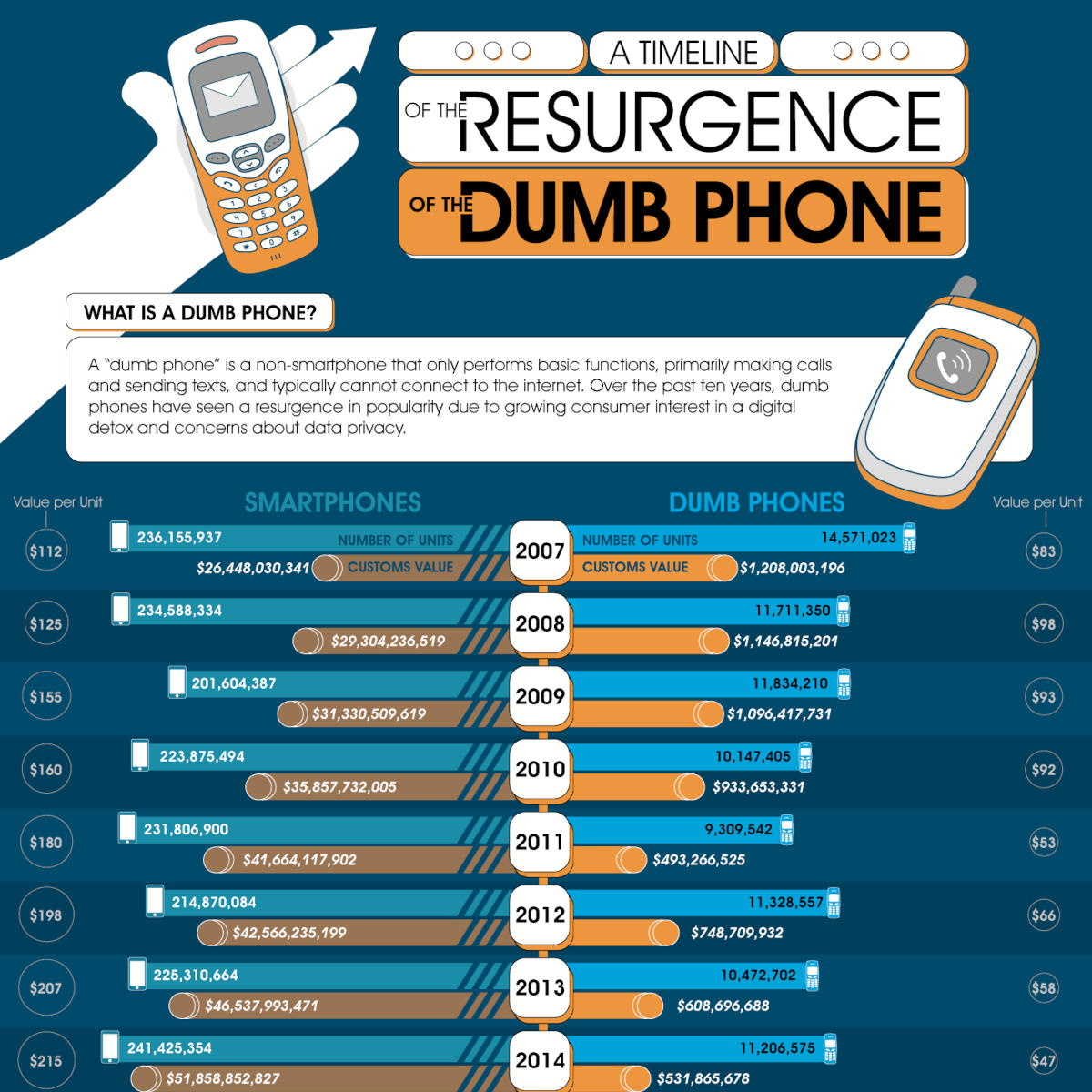
By 2007, smartphones had won the cell phone war, with 268 million units imported versus 14.5 million for old flip phones. But Ooma’s import data tells a more interesting and nuanced story than one of smartphone dominance. It shows a gradual reversal of fortune. Through the 2010s, imports of dumb phones waned as app stores and mobile internet grew and improved. By 2014, smartphone imports peaked at 241 million, and dumb phones reached a low of 9.2 million. That’s a big discrepancy, but then dumb phones made a shocking comeback.
Between 2015 and 2019, imports of dumb phones began to rise again. They reached a peak of 18.9 million units (about $3.5 billion in value) imported in 2022. Post-pandemic supply chain corrections might have inflated these numbers, but it’s also clear that demand for dumb phones shifted. Even after 2022’s market spike, dumb phone imports remained above mid-2010s levels. That means a small but persistent segment of the cell phone market is deliberately downgrading to simpler options.
The reasons for this shift are clear. Screen time has been linked to many negative health outcomes: poor sleep, poor eyesight and posture, headaches, eye strain, depression, anxiety, and a host of other problems. Add to this the data security concerns around smartphones, and it’s less surprising that people would prefer a simpler phone option. The average smartphone can track your location, log your biometric data, and sell your information to advertisers and other entities. Not so for the dumb phone, which is stripped down and focused solely on calling and texting. No more late-night doom scrolling. No captures of your face and voice.
The interest in dumb phones seems to be more than a niche revolt. There’s sustained evidence that we can’t assume the smartphone is the only option for connectivity and that more is always more. A dedicated base of consumers wants something simpler, and their numbers just might grow.