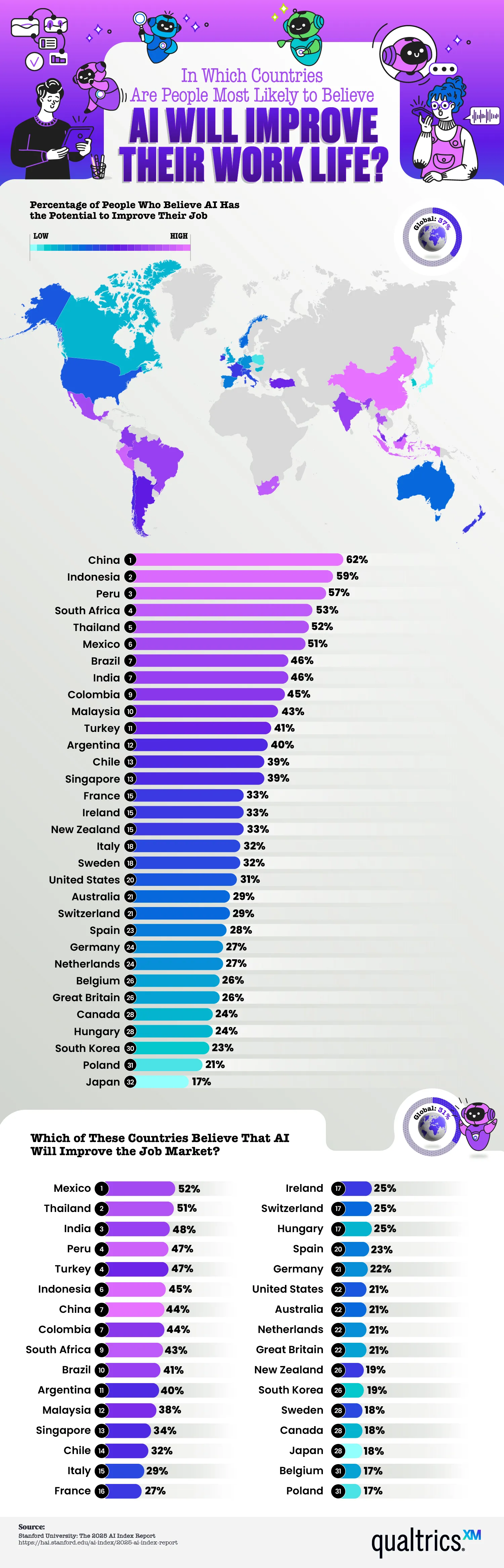
Imagine two workers, one in Bangkok and one in Birmingham, UK. Both open the same AI-enabled software on a Monday morning, but where one sees opportunity, the other sees a clock counting down to redundancy—the same technology viewed from two drastically different perspectives. A new Qualtrics study on the percentage of workers who feel AI will improve their work life shows just how mixed these opinions are.
Qualtrics surveyed 32 countries and color-coded them by the percentage of people who think AI will improve their work experience. Over 50% of workers in China, Indonesia, Peru, South Africa, and Thailand are optimistic about the effects AI will have on their jobs. In the Anglosphere and Western Europe, workers are much more skeptical, with 35% or fewer feeling that AI is a threat to their work lives. Japan is the most skeptical, with only 17% feeling positively about AI. The team also examined optimism about AI’s effects on the job market. Mexico leads that optimism, and Belgium and Poland tie for the most skeptical.
There are many explanations for why these differences are so stark. China leads the optimistic end of the spectrum, possibly because of the government’s heavy investment and positive messages about AI. People in developing economies are more likely to see AI as a way to bridge gaps and help them reach prosperity through new opportunities and narrower skill gaps. In wealthier nations, AI is framed more as a disruptor of an already stable economy, where satisfied workers feel it will disturb the good.
Research shows that workers can be cautiously optimistic because AI tends to reshape jobs rather than eliminate them wholesale. The global story of AI is still unfolding, and workers’ feelings and attitudes will certainly shape how it unfolds.